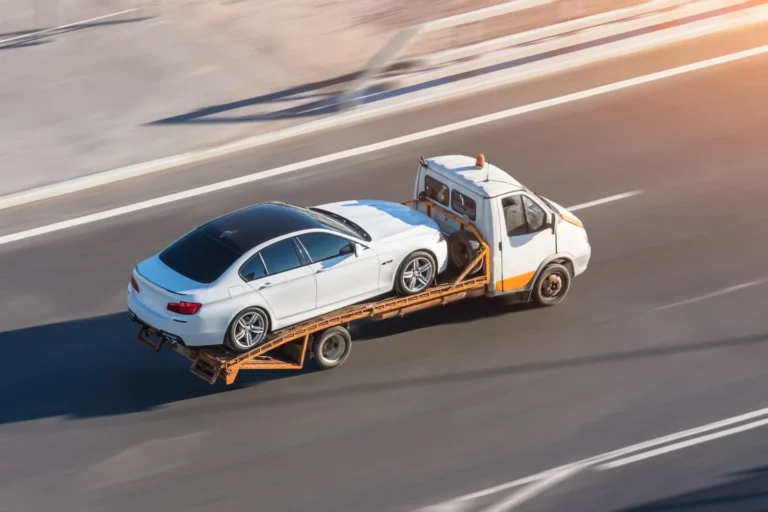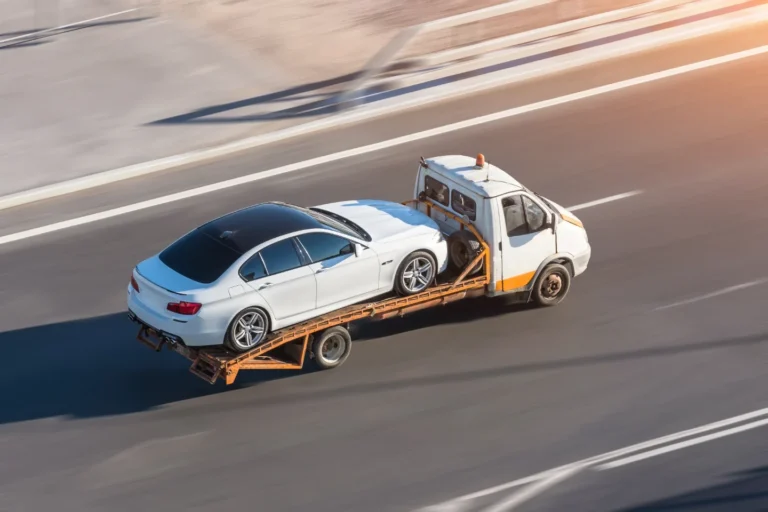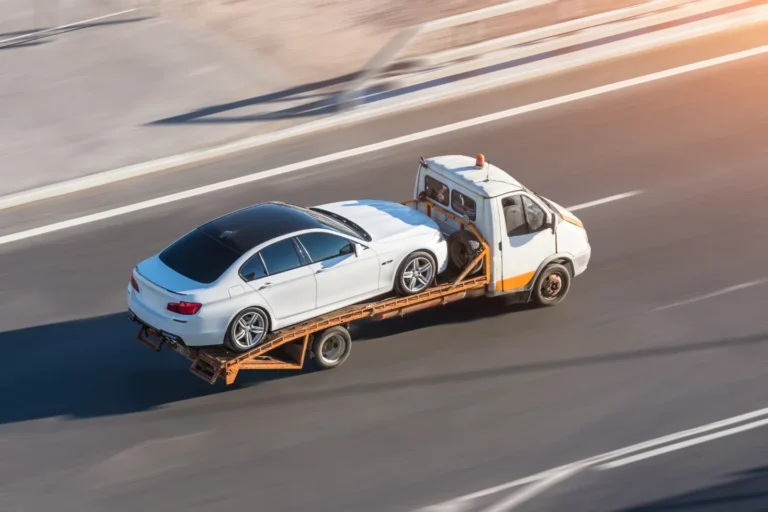

Quick answer: A car that does not start can be sold in New Jersey exactly as it is. You do not need to fix it, jump it, get it inspected, or get it to the buyer. What you need is the title in your name, matching photo ID, a lien release if it was ever financed, and to take the plates off before it goes. The flatbed handles the rest. What changes from one non-running car to the next is not the paperwork — it is what the buyer can recover and how hard the car is to load, and this guide walks through every common cause on both counts.
What you do, and what the tow does
| Your job | The tow’s job |
|---|---|
| Confirm the title is in your name and any lien is released | Getting the car onto the truck — winch, skates or dollies as needed |
| Describe the car accurately: what’s wrong, does it roll, does it steer, where is it | Bringing the right equipment for that description |
| Clear out personal belongings and remove the plates | Moving a car that will not move under its own power |
| Be there with ID and the title at collection | Loading in tight driveways, on slopes and from street parking |
The seller’s whole job fits in the left column. Nothing there requires the car to run.
Running, non-running, wrecked: what the categories mean
Buyers sort vehicles into rough categories, and it helps to know which yours is in. These are categories, not price bands.
- Running — starts, drives, may or may not be roadworthy. Has a resale market beyond scrap.
- Non-running — does not start or cannot be driven, but is complete. Valued on metal, parts and the catalytic converter.
- Wrecked or stripped — collision damage, missing major components, or partially parted out. Valued mostly on metal, with recoverable parts if any remain.
Most of what follows sits in the middle category. For what actually moves the number inside it, see what a junk car is worth in New Jersey.
Engine failure: seized, cracked block, thrown rod
The engine is the single most valuable component on most cars, so its condition matters more to a buyer than almost anything else. A seized or cracked engine removes it from the parts column and leaves the car as weight plus whatever else is intact.
What to tell the buyer: what happened (overheated, lost oil, knocked, just stopped), whether the engine is still in the car, and whether it turns over at all. An engine that cranks but will not fire is a different proposition from one that is locked solid, and an honest description gets you a firm figure. Do not pay a shop to diagnose it further if you have already decided to sell.
Transmission: slipping, no reverse, won’t engage
Transmission failures are often the moment an older car becomes economically dead, because replacement costs approach the car’s value. The car may start and idle perfectly and still be immovable under its own power.
For collection, the question is whether the car rolls in neutral. Most do. If it does not, or if the shifter is stuck in park, say so — it changes the equipment needed and it is far better known in advance.
Check engine light
A lit check engine light is not a non-running condition by itself, but it is frequently the reason a car will not pass New Jersey’s emissions inspection, which for many owners is the practical end of the road. The light means an active fault code is stored. Clearing it does not fix the fault and resets the readiness monitors, so the car fails on that instead.
To a licensed buyer the light is irrelevant — the car is not being registered for road use. To a private buyer it is a real obstacle. If the diagnosis is the catalytic converter, see below.
Dead battery after storage
A car that has sat for months will often not start simply because the battery is flat. Before concluding it is dead, it is worth a jump — not because a buyer needs it running, but because a car that starts is easier to describe accurately and easier to load.
If it starts and runs, you have a running car with a storage history, not a non-running one. If it starts and then reveals other faults, you know what they are. Either way the sale proceeds.
Sat through New Jersey winters
A vehicle left outside over several winters accumulates the same problems in the same order: the battery dies, the tyres go flat and take a set, the brakes seize to the discs, and salt-laden slush corrodes the underbody. Rodents move in. By the third winter it is usually a winch job.
None of this stops a sale. It does mean the car is likely to not roll, which is the single most useful thing to tell the buyer when you book. The longer it sits, the more of the recoverable value corrodes away, so if the decision is made, make it before the next winter rather than after.
Flat tyres and frozen brakes
These are loading questions, not value questions. A car on four flats can be winched onto a flatbed; a car with seized brakes can be loaded on skates or dollies. Both take longer than a rolling car and need the right truck.
Say so when you book. A driver arriving with a wheel-lift for a car that needs a flatbed and skates is a wasted visit, and the reschedule is on you.
Missing keys
You can sell a car without keys. The car cannot be steered without the ignition unlocked, which makes loading harder, but it is routine. It does not affect the title transfer at all.
Declare it. If the car is in a position where it must be steered to be extracted — a garage, a tight driveway — the buyer needs to know.
Missing catalytic converter
Converter theft has been widespread across New Jersey, and a stolen converter is often what a check engine light and a loud exhaust are telling you. The converter is priced separately from the rest of the car because of its precious-metal content, so its absence is the one missing part that materially changes an offer.
Tell the buyer before the quote. A car quoted as complete and found without its converter at pickup will be revised on the spot, which is the outcome nobody wants. A car quoted honestly as missing its converter gets a lower but firm figure.
The car is stuck at a repair shop
A common and awkward situation: the car was towed to a facility, the diagnosis came back, the repair is not worth doing, and now the shop is holding the car against a diagnostic or storage bill.
Two things are true at once. First, you cannot sell a vehicle you do not have possession of, and a buyer cannot collect it from a shop without the shop’s agreement. Second, a shop holding a car against an unpaid bill is in a mechanic’s-lien position with its own MVC route for eventually titling the vehicle — that is the shop’s process, not yours.
The way through is to settle what is owed and either have the car released to you or, with the shop’s agreement, have the buyer collect it directly from there. Many shops prefer this to storing a dead car. Agree it in writing before booking. If the title itself is complicated, the title problems guide covers the routes.
Transferring ownership of a non-running car
The paperwork is identical to a running car. You sign the seller’s section on the reverse of the title, provide a bill of sale with the buyer’s name and address, the date, the odometer reading and the price, and the buyer completes the transfer at an MVC agency. No inspection is required for the transfer, and New Jersey does not require the vehicle to be operable to change hands.
For a car going for salvage or recycling, the title will eventually be branded junk or salvage by the MVC in the buyer’s process. That happens after the car leaves you and is not something you do. What you should get is a dated receipt on company letterhead with the VIN — the MVC accepts exactly that as proof the vehicle was junked when you clear the registration, per its Uninsured Motorist FAQ.
After it goes: plates and insurance, in that order
Take the plates off before the truck leaves and surrender them to the MVC. Only then cancel the insurance. Cancelling first, while the plates are still registered to you, triggers a suspension from the MVC’s Uninsured Motorist unit. The full sequence is in the plate surrender guide.
Where it is parked matters
A non-running car on a public street in New Jersey is exposed to municipal enforcement and towing; on a driveway it may still be subject to local ordinances on inoperable vehicles. The rules vary by municipality. If the car has been sitting long enough for a notice to arrive, see New Jersey vehicle laws and municipal rules — and sell before the deadline on the notice rather than after.
What to have ready when you call
- Year, make and model.
- What is wrong, in a sentence.
- Does it start? Does it roll? Does it steer?
- Is the catalytic converter fitted? Are the wheels on?
- Is the title in your name, and is there a lien on it?
- Where exactly is the car, and can a flatbed get to it?
Six answers, and a buyer can give you a firm figure. CashSellCar buys non-running, damaged and end-of-life vehicles across New Jersey and nationwide from our office in Jacksonville, Florida, collects by flatbed at no charge, and pays at collection. Get a free, no-obligation offer or call 844-512-0697.
Related New Jersey guides
All six guides are linked from the New Jersey hub. If the car is damaged rather than merely dead, see selling a damaged car in New Jersey. We collect statewide, including Paterson, Edison and Trenton.
Ready to see what your car is worth?
Get a real online offer with free towing and no obligation.
Get my instant offer